-
September 29, 2026
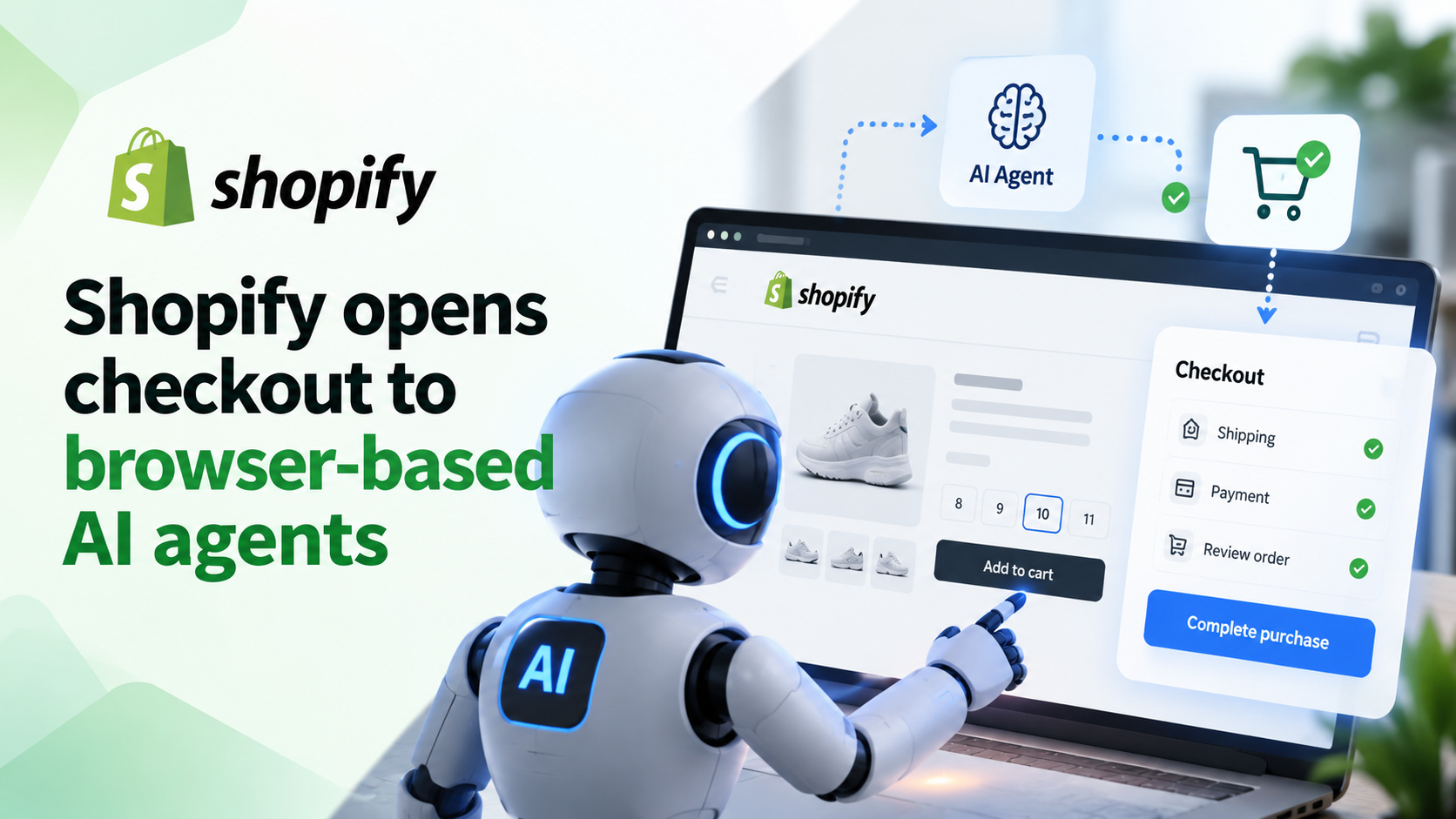
Shopify Opens Checkout to Browser-Based AI Agents
Shopify is taking another major step toward agentic commerce by allowing browser-based AI agents to interact with Shopify checkout and help customers complete purchases.
On September 28, Shopify announced WebMCP support for checkout, extending the capabilities already available to browser-based AI agents across Shopify storefronts and carts. With the new functionality, AI agents can move beyond product discovery and cart management and assist with the checkout process itself.
What Is Changing?
Previously, browser-based AI agents could interact with Shopify storefronts to discover products, search catalogs, and add products to a shopping cart.
With checkout support, agents can now interact with the active Shopify checkout in the buyer's browser.
According to Shopify's developer documentation, the new checkout tools allow agents to:
- Read the current checkout
- View checkout messages and information
- Update supported checkout details
- Help with delivery and customer information
- Complete the checkout after the buyer confirms the purchase
- Access relevant order information after completion
Shopify specifically introduced three key checkout tools:
get_checkoutupdate_checkoutcomplete_checkout
These tools provide structured access to checkout rather than requiring an AI agent to rely on screenshots, DOM scraping, or interfaces designed exclusively for human users.
How AI-Powered Checkout Works
The basic workflow can be viewed as:
Product Discovery → Cart → Checkout → Customer Confirmation → Purchase
An AI agent operating inside the customer's browser can interact with the Shopify storefront, help select products, manage the cart, inspect checkout information, make supported changes, and ultimately submit the order after the buyer authorizes the transaction.
Shopify says the WebMCP checkout tools operate using the same state as the checkout UI.
Importantly, when customer interaction is required — for example, during certain authentication or blocking checkout experiences — control can be handed back to the buyer.
Shopify and the Rise of Agentic Commerce
This development is part of Shopify's broader strategy around agentic commerce.
Shopify and Google have developed the Universal Commerce Protocol (UCP), an open standard designed to allow AI agents and commerce systems to interact with merchants across product discovery, cart creation, checkout, payments, and post-purchase workflows.
UCP is designed to provide common commerce capabilities while allowing different technologies and transports — including REST, GraphQL, MCP, and agent-to-agent protocols — to participate in commerce workflows.
This means Shopify is increasingly positioning its platform not only as an eCommerce platform for human shoppers, but also as infrastructure that can support AI-driven shopping experiences.
What Is WebMCP?
WebMCP is designed to give browser-based AI agents structured tools for interacting with websites.
Instead of an agent attempting to understand a website purely through HTML, screenshots, or simulated clicks, WebMCP allows websites to expose functionality specifically designed for agent interaction.
For Shopify, this means an AI agent can use structured commerce tools throughout the shopping journey.
Shopify's latest update extends those capabilities into checkout.
Three New Checkout Tools
1. get_checkoutThis tool allows an agent to retrieve information about the current checkout.
The agent can use this information to understand the current state of the transaction before taking further action.
2. update_checkoutThis allows an agent to update supported checkout information.
Depending on the checkout context, this can include information such as customer or delivery details.
3. complete_checkoutThis is the final step.
The agent can submit the checkout after the buyer provides the required authorization.
Shopify's documentation emphasizes that buyer control remains part of the process, particularly when additional authentication or customer interaction is required.
Why This Matters for Shopify Merchants
For Shopify merchants, this could eventually change how customers discover and purchase products.
Traditional eCommerce generally follows this path:
Google/Search → Website → Product Page → Cart → Checkout → Payment
Agentic commerce introduces another possibility:
Customer → AI Agent → Product Discovery → Cart → Checkout → Purchase
Instead of manually navigating every page, customers could increasingly describe what they want to an AI assistant and allow the agent to handle much of the shopping workflow.
Shopify's broader agentic commerce infrastructure is designed to make merchant catalogs and checkout experiences available across AI-powered shopping surfaces.
What About Shop Pay?
Shopify's WebMCP checkout support also covers checkout experiences involving Shop Pay, according to reporting on the announcement.
This is significant because payment and authentication are some of the most sensitive parts of an agentic purchasing workflow.
The buyer remains involved when authorization or additional authentication is required, rather than giving an AI agent unrestricted control over the transaction.
What Shopify Developers Should Consider
For Shopify developers, agentic commerce creates a new development consideration: storefronts may increasingly need to work for both humans and AI agents.
Developers should pay attention to:
- Accurate product data
- Clear product descriptions
- Variant information
- Pricing and availability
- Shipping information
- Return policies
- Checkout requirements
- Structured commerce data
- AI-friendly storefront functionality
- Shopify's WebMCP and UCP ecosystem
Shopify has also been expanding its developer tooling around agentic commerce, including access to UCP and tools for building end-to-end AI commerce experiences.
The Future of Shopify Commerce
The latest WebMCP update represents another step toward a model where AI agents become a new shopping interface.
Instead of customers always visiting a website themselves, an AI agent may increasingly help them discover products, compare options, manage carts, and assist with checkout.
For Shopify merchants, this means the traditional storefront may no longer be the only place where customers interact with their products.
The next generation of eCommerce could involve websites that are designed not only for people to browse, but also for AI agents to understand and interact with commerce systems in a structured and reliable way.
Shopify's latest WebMCP checkout release brings that vision one step closer to reality.
Key Takeaways
- Shopify has expanded WebMCP support to checkout.
- Browser-based AI agents can now interact with Shopify checkout.
-
New tools include
get_checkout,update_checkout, andcomplete_checkout. - Customers remain involved when authorization or additional authentication is required.
- Shopify's Universal Commerce Protocol (UCP) provides a broader foundation for agentic commerce.
- Shopify developers should start considering how products, storefronts, and checkout experiences will work with AI agents.
Source: Shopify Developer Changelog, September 28, 2026; Shopify Universal Commerce Protocol documentation.
- No comments yet
- By Admin

Comments